top of page

The Eye That Never Blinks: Flock and ALPR

  • Writer: Gregory T. Moro, Esq.
    Gregory T. Moro, Esq.
  • 11 minutes ago
  • 13 min read

M O R O     &     M O R O ,     A T T O R N E Y S     A T      L A W

Emerging Technology & Digital Forensics Series


Flock Cameras, ALPRs, and the Fourth Amendment’s Tipping Point


By: Gregory T. Moro, Attorney at Law

May 2026


Introduction: The Road That Remembers


There was a time, not so long ago, when driving your car down a public road was an act of practical anonymity. You were, for all legal purposes, just another vehicle in the current. A police officer standing on a corner might jot down a license plate number if something caught his attention, but there was no mechanism to capture, store, and cross-reference the plate of every car that passed through an intersection on a Tuesday afternoon. That world no longer exists.


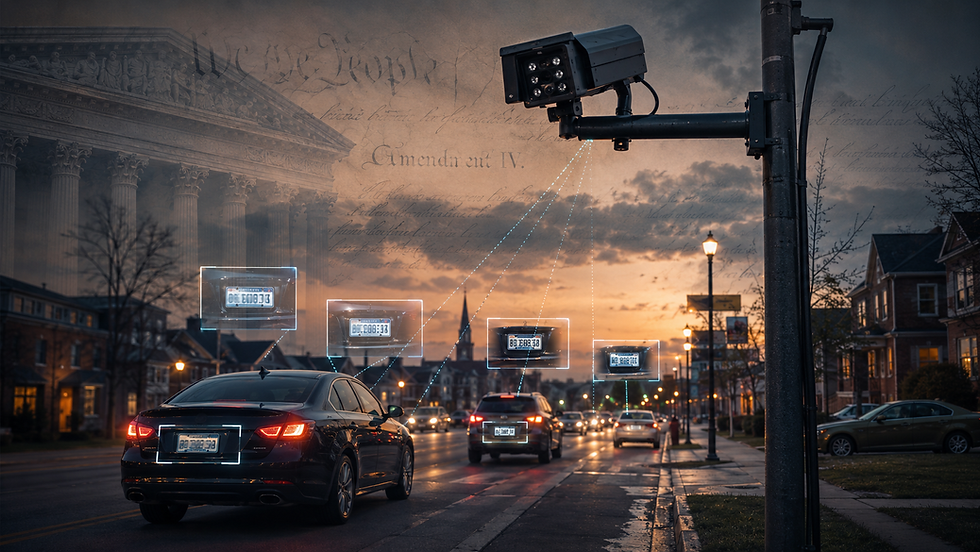
Automated License Plate Reader systems, commonly known as ALPRs, have changed the equation. These high-speed camera networks, often manufactured and operated by private companies like Flock Safety, sit mounted on street poles, traffic signals, and utility infrastructure, silently photographing every vehicle that passes. The cameras do not distinguish between suspects and commuters. They record everyone. The data (plate number, vehicle make and model, color, time, date, GPS coordinates, and in some configurations, bumper stickers, roof racks, and other identifying features) is uploaded to a cloud-based database accessible to law enforcement agencies across jurisdictions, often without a warrant, without probable cause, and without the driver ever knowing it happened.


Flock Safety alone now operates in more than 5,000 law enforcement agencies and 6,000 communities nationwide. The constitutional reckoning has been slow in arriving, but it is arriving. In 2018, the U.S. Supreme Court held in Carpenter v. United States, 585 U.S. 296 (2018), that the government’s acquisition of seven days of historical cell-site location information constituted a “search” under the Fourth Amendment, precisely because of the “detailed, encyclopedic, and effortlessly compiled” nature of the data. Carpenter did not address license plate readers directly. But its logic, that technology enabling cheap, pervasive, retroactive surveillance of ordinary citizens triggers constitutional scrutiny, casts a long shadow over every ALPR network operating in America today.


For practitioners in the Commonwealth of Pennsylvania, the stakes are particularly acute. Pennsylvania has no comprehensive ALPR statute. Flock cameras are expanding across the state, including in Erie County, where Millcreek Township’s Board of Supervisors fielded pointed public questions about privately owned Flock cameras in January 2026. Pending legislation (SB 933) would establish a permitting process for deploying readers on PennDOT infrastructure, but the bill remains in committee. In the meantime, the constitutional framework is developing case by case, and the defense bar must be prepared to meet it.


I.  How the Technology Works: More Than a Camera

It is important to understand what an ALPR system actually does, because the legal analysis depends on it. A single Flock camera is not a speed trap or a red-light camera. It is a networked sensor that captures a still image of every vehicle passing within its field of view, typically several thousand plates per hour, and runs each image through optical character recognition software to convert the plate into searchable text. The resulting data record includes the license plate number, timestamp, GPS coordinates, and a photograph of the vehicle. Flock’s proprietary software also generates what the company calls a “vehicle fingerprint” based on characteristics like color, make, model, body type, and visible accessories.


That data is uploaded to Flock’s cloud servers and made available to subscribing law enforcement agencies. Officers can search for a specific plate, generate a “vehicle journey map” showing everywhere that car has been observed, analyze movement patterns, flag repeat visitors to a location, identify vehicles frequently seen traveling together, and, according to Flock’s own marketing materials, “predict the future route a vehicle might take.”


The company has also announced that police departments will soon be able to obtain not just still photographs but video, including live feeds and 15-second clips of vehicles passing the cameras. This is no longer a snapshot at a single intersection. It is an evolving surveillance infrastructure.


And critically, the data is not siloed. Flock operates what amounts to a nationwide network. An agency in Pennsylvania can query plates captured by cameras in Ohio, Virginia, or California. A recent investigation by the Virginia Center for Investigative Journalism revealed that federal agencies, including ICE, attempted to access local ALPR data from Virginia municipalities thousands of times for immigration enforcement purposes before that state enacted its own ALPR statute in 2025.


II.    The Constitutional Landscape: Carpenter’s Shadow

The Fourth Amendment protects “[t]he right of the people to be secure in their persons, houses, papers, and effects, against unreasonable searches and seizures.” For most of American history, that protection was understood to require a physical trespass: the government had to physically enter your home, open your mail, or seize your property. That changed with Katz v.

United States, 389 U.S. 347 (1967), which introduced the “reasonable expectation of privacy” test. And it changed again, dramatically, with Carpenter.

In Carpenter, the Court recognized that certain forms of digital surveillance are so comprehensive, so effortless, and so retrospective that they give the government a power it has never had before: the ability to “travel back in time” and reconstruct a person’s movements with a precision that would have required an army of agents in any prior era. Chief Justice Roberts wrote that such surveillance provides “an intimate window into a person’s life, revealing not only his particular movements, but through them his ‘familial, political, professional, religious, and sexual associations.’” The Court held that the government needed a warrant.

The question that now confronts lower courts is straightforward: does an ALPR network, particularly one as dense and data-rich as Flock’s, cross the same constitutional line?


A.  The Mosaic Theory

The analytical framework most relevant to ALPR litigation is what scholars call the “mosaic theory” of the Fourth Amendment. The concept first gained traction in Justice Alito’s concurrence in United States v. Jones, 565 U.S.

400, 430 (2012), where he observed that “society’s expectation has been that law enforcement agents and others would not—and indeed, in the main, simply could not—secretly monitor and catalogue every single movement of an individual’s car for a very long period.”

The mosaic theory holds that individual observations, each one innocuous on its own, can, when aggregated, constitute a search. A single photograph of your license plate at a particular intersection may be trivial. Hundreds of such photographs, taken over weeks by a network of cameras across a metropolitan area, begin to tell a story that no single data point could. They reveal where you sleep, where you worship, which doctor you visit, which political rallies you attend, and whether your car has been parked overnight at an address that is not your own.

This is precisely the argument that civil liberties organizations, including the ACLU and the Institute for Justice, are now pressing in ALPR litigation across the country.


B.  The Current Split: Schmidt, Simonson, and the San Jose Class Action

The case law is developing rapidly. The most significant recent decision is Schmidt v. City of Norfolk, No. 2:24-cv-342 (E.D. Va. Jan. 27, 2026), in which Chief Judge Mark S. Davis granted summary judgment to the City, holding that Norfolk’s 176-camera Flock network did not violate the Fourth Amendment. The court found that the cameras captured “snapshots” of daily life but did not continuously track individuals or generate enough data to reconstruct whole routines. The plaintiffs’ vehicles had been photographed hundreds of times (526 and 849 times respectively), but the observations were separated by distances of several miles and intervals of 40 to 50 minutes, leaving what the court called “sizable gaps” in their movements.


But Judge Davis did not stop there. In a passage that should concern every law enforcement agency relying on ALPR technology, he wrote: “ALPR surveillance could become too intrusive and run afoul of [constitutional privacy standards] at some point.” He acknowledged a tipping point. The system was constitutional in Norfolk “today,” he said, a word chosen with evident care, but the calculus shifts as camera density increases.


Days later, the Washington Court of Appeals reached a similar result in State v. Simonson (Wash. Ct. App. Jan. 29, 2026), holding that a single Flock image captured on a public roadway did not implicate constitutional privacy protections. Again, the court emphasized the limited scope of the deployment.


Then, in April 2026, the Institute for Justice filed a new class action lawsuit challenging San Jose’s 474-camera Flock network, a system that has expanded from four cameras at one intersection to a citywide surveillance apparatus in just five years. The complaint alleges that San Jose’s system, combined with Flock’s AI software and cross-jurisdictional data sharing, enables precisely the kind of “dragnet” surveillance that Carpenter condemned. More than 1,000 city employees are authorized to search the data without a warrant, probable cause, or individualized suspicion. The plaintiffs are seeking a court order requiring deletion of images and data within 24 hours absent a warrant.


The trajectory is unmistakable. Courts have been willing to uphold smaller, more limited deployments. But the technology is not standing still, and neither is the litigation.


III.  The Collection-Versus-Use Distinction

One of the most important analytical distinctions in ALPR jurisprudence, and one that defense attorneys must understand, is the difference between collection and use of plate data. Courts have generally held that the initial capture of a license plate in plain view on a public roadway does not constitute a “search” under the Fourth Amendment. This is consistent with the long-standing principle that a person traveling on public streets has no reasonable of privacy in the exterior of their vehicle or the license plate affixed to it. As Flock Safety’s own white paper argues, ALPRs “observe vehicles, not people.”


But what happens after that initial capture is a different matter entirely. When police query a database to track a specific vehicle’s movements over time, reconstruct travel patterns, identify frequent associates, or predict future routes, the nature of the government’s activity changes. The discrete observation becomes persistent surveillance. And it is here, at the point of use, aggregation, and retention, that the most promising defense challenges will be found.


Consider the practical implications. If a defendant’s vehicle was identified through a Flock “hot list” alert (a real-time notification triggered when a camera captures a plate matching a stolen vehicle report, active warrant, or BOLO), the evidentiary challenge is relatively narrow. But if investigators used Flock's database to retroactively reconstruct a defendant’s movements over days or weeks, or to build a pattern-of-life analysis linking the defendant to particular locations, the Carpenter framework comes squarely into play. The defense must demand discovery on how the data was used, not merely that it was collected.


VI.   The Third-Party Doctrine and the Private Actor Problem

Flock Safety is not a government agency. It is a private company headquartered in Atlanta, Georgia, that manufactures cameras, operates cloud infrastructure, and sells subscriptions to law enforcement. This creates a doctrinal wrinkle that defense practitioners must confront: the Fourth Amendment, by its terms, constrains government action, not private conduct.


Historically, if a person voluntarily shared information with a third party (a bank, a phone company, a landlord), the government could obtain that information without a warrant under the “third-party doctrine.” Carpenter weakened but did not eliminate this doctrine, holding that “a person does not surrender all Fourth Amendment protection by venturing into the public sphere.”


In the ALPR context, the third-party doctrine creates a potential end-run around constitutional protections. Flock collects the data on its own servers. Law enforcement agencies subscribe to access it. If the data is characterized as a voluntary third-party business record, police may argue that no warrant is required. Plaintiffs in the San Jose litigation argue the opposite: that when a private surveillance system is “deeply integrated” with law enforcement, when police effectively outsource their surveillance function to a private contractor, the Fourth Amendment still applies.


This question is unresolved, and the answer may determine whether ALPR evidence stands or falls in thousands of criminal cases nationwide. Defense attorneys should not wait for the Supreme Court to settle it. The argument is available now, in every case where Flock data is offered against a defendant.


V.  The Scope of Misuse: From Immigration Enforcement to Reproductive Surveillance

The constitutional arguments are not academic abstractions. They are grounded in documented misuse.


The ACLU has reported that ICE accessed Flock’s nationwide ALPR database to support immigration enforcement operations. A 2025 study by the Center for Human Rights at the University of Washington found that U.S. Border Patrol accessed and searched ALPR databases in numerous Washington State localities, potentially in violation of that state’s Keep Washington Working Act. In Virginia, before the state enacted its ALPR statute, outside law enforcement accessed one small town’s Flock data nearly seven million times in a single year.


Perhaps most troubling, a Texas law enforcement officer was documented using the Flock system to conduct a nationwide search for a woman who had obtained a self-administered abortion, conduct that is criminalized in Texas. An abortion rights organization reported that women were already expressing “overwhelming fear” that they were “being watched and tracked by the state.”


A study from Christopher Newport University found that Flock cameras in the Hampton Roads region of Virginia were not distributed equally; they were concentrated in and around Black communities. This finding echoes a broader pattern. Surveillance technologies do not fall evenly on everyone. They fall on the people who are already most surveilled.


For defense counsel, these facts are not merely policy concerns. They are evidentiary arguments. If the government cannot demonstrate that ALPR data was obtained and used in compliance with the Fourth Amendment, and if the evidence suggests a pattern of discriminatory or pretextual deployment, the data may be subject to suppression.


VI.  Pennsylvania’s Position: Article I, Section 8 and the Legislative Vacuum

Pennsylvania’s Constitution provides an independent basis for suppression of evidence obtained through unreasonable searches. Article I, Section 8 mirrors the Fourth Amendment in language but has been interpreted by the Pennsylvania Supreme Court to afford broader protections in certain contexts. In Commonwealth v. Edmunds, 586 A.2d 887 (Pa. 1991), the Court established a four-factor framework for analyzing state constitutional claims independently of federal precedent, considering: (1) the text of the Pennsylvania constitutional provision; (2) the history of the provision, including Pennsylvania case law; (3) related case law from other states; and (4) policy considerations.


This is a critical tool for defense attorneys. Even if federal courts continue to uphold limited ALPR deployments under the Fourth Amendment, Pennsylvania’s Article I, Section 8 provides an independent ground for challenging ALPR evidence in Commonwealth courts. The Edmunds framework invites precisely the kind of analysis that ALPR cases demand: a careful weighing of individual privacy interests against the state’s legitimate law enforcement objectives, informed by the specific characteristics of the technology at issue.


Adding urgency to this analysis is Pennsylvania’s legislative vacuum. The Commonwealth has no comprehensive ALPR statute. There are no statewide data retention limits, no mandatory audit trails, no restrictions on cross-jurisdictional data sharing, and no prohibition on federal agency access to locally collected plate data. HB 1125, introduced in the 2025–2026 session, would establish a permitting process and define authorized uses, but the bill has not advanced. Senator Picozzi’s SB 933 would allow deployment on PennDOT infrastructure but likewise remains in committee.


In the absence of legislation, the courts are the only check. And the defense bar is the only voice asking the courts to act.


VII.   Defense Strategies: Practical Considerations

For the criminal defense practitioner in Pennsylvania, ALPR evidence will increasingly appear in discovery. The following strategies should be considered in every case where such evidence is offered:

Demand Comprehensive Discovery. Do not accept a bare assertion that a defendant’s vehicle was observed at a particular location. Request the complete audit trail: who queried the database, when, under what authority, what search parameters were used, how long the data had been retained, and whether the query was part of a targeted investigation or a suspicionless dragnet. Flock’s system generates audit logs. The prosecution should be compelled to produce them.


Challenge the Scope of Surveillance. If the government used ALPR data to reconstruct a pattern of movement over days or weeks, argue that Carpenter requires a warrant for precisely this kind of retrospective location tracking. The Schmidt court itself acknowledged a tipping point.

Push the court to identify where that line falls in the specific case.


Raise Article I, Section 8. Pennsylvania’s state constitution may provide broader protection than the Fourth Amendment. File a motion under the Edmunds framework, arguing that the warrantless collection and retrospective querying of ALPR data violates the Commonwealth’s independent privacy protections. The absence of state legislation governing ALPRs is itself a policy argument: the legislature has not authorized this surveillance, and the courts should not presume that it is constitutionally permissible.


Investigate Cross-Jurisdictional Access. Determine whether federal agencies (including ICE, the DEA, or the FBI) accessed locally collected ALPR data in the investigation. If so, challenge the legal authority for that access, particularly in light of pending federal legislation like the Fourth Amendment Is Not For Sale Act, which would restrict government purchases of commercially available surveillance data.


Attack the Reliability of the System. ALPRs are not infallible. Optical character recognition software misreads plates. Cameras capture partial images. Vehicle fingerprinting algorithms produce false matches. If the prosecution’s case depends on ALPR identification, demand validation data: error rates, false positive rates, and the specific confidence threshold applied in the defendant’s case.


Raise Selective Deployment. If the cameras in the jurisdiction are concentrated in minority communities, as has been documented in Hampton Roads, Virginia, argue that the surveillance system operates as a discriminatory enforcement mechanism, raising equal protection concerns alongside the Fourth Amendment challenge.


Conclusion: The Tipping Point Is Closer Than You Think

Judge Davis’s observation in Schmidt deserves to be read carefully. He did not say that ALPR surveillance is constitutional. He said it is constitutional today, in Norfolk, with 176 cameras. He explicitly recognized that the analysis changes as the technology expands. San Jose has 474 cameras. Flock has announced video capabilities and AI-enhanced tracking tools. The network grows every month.


The Supreme Court in Carpenter warned that the Court must not “allow police to achieve indirectly what the Constitution prohibits them from doing directly.” Outsourcing mass surveillance to a private company and then purchasing access to the data is precisely the kind of indirect achievement that should give courts pause.

For the defense bar, the message is clear: this evidence is challengeable. The case law is in motion. The constitutional arguments are strong and getting stronger. And in Pennsylvania, where no statute governs this technology and Article I, Section 8 provides independent protection, the ground is especially fertile for the defense attorney who is willing to till it.


At Moro & Moro, we remain at the forefront of this technical-legal nexus, helping clients navigate the complexities of digital forensics, Fourth Amendment protections, and the rapidly evolving landscape of surveillance-related litigation in the Commonwealth of Pennsylvania.


About the Author

Attorney Gregory T. Moro

Gregory T. Moro is a seasoned litigator with over three decades of experience in both civil and criminal advocacy. A founding partner of Moro & Moro, Attorneys at Law, based in Danville, Pennsylvania, Mr. Moro is admitted to the Supreme Court of the United States, the U.S. Federal Court for the Third Circuit (Middle District), and the courts of the Commonwealth of Pennsylvania. He earned his Juris Doctor from the University of Dayton School of Law and graduated cum laude from the University of Scranton.

Flock cameras are watching and monitoring traffic.

NOTHING IN THIS OR ANY OTHER BLOG POST CONSTITUTES LEGAL ADVICE OR FORMS AN ATTORNEY-CLIENT RELATIONSHIP BETWEEN THE FIRM AND THE READER. INFORMATION ORIGINATING FROM THIS WEBSITE IS INTENDED FOR EDUCATIONAL PURPOSES ONLY.


Disclaimer: This analysis is intended for professional informational purposes and does not constitute legal advice. The data retention policies, device capabilities, and manufacturer terms of service discussed herein are subject to change. Consult with counsel regarding the specific application of the Fourth Amendment, Article I Section 8, and the Pennsylvania Rules of Evidence to your matter.


Comments

Rated 0 out of 5 stars.
No ratings yet

Add a rating
bottom of page